Fun day...

Since I am among other things, a member of the Drupal security team, I sometimes get contacted about the security of particular modules or sites.

Today was such a day. A Drupal site developer had some suspicions about a contrib module being unsafe, since three of his clients' sites got "hacked". I asked about the symptoms and was told that a call to an advertising site got inserted into index.php.

This fact alone told me two things:

1) It is not Drupal specific; index.php is used by many PHP applications.

2) It is unlikely that Drupal was the attack vector used. Most systems do not allow the Apache user to modify PHP files.

A cursory look at the named module also didn't reveal anything particular unsafe.

I shared these observations with the concerned developer and I also suggested that somebody guessing the passwords or using a trojan might be responsible.

The internets are like totally evil

This isn't exactly news, but I was always assuming that Drupal people are a bit more honest and reliable. Turns out that I am pretty naïve.

As you know, we have these fancy download stats, thanks to a lot of people's work. On occassion, there are some troubles with them, and then Brandon looks at them in detail. Today, we blocked an IP which was requesting updates very often and with a lot of different keys. Either somebody's Drupal site is broken in a bad way, or somebody was trying to tweak the stats. We can't decide this based on the data we have, but if you find you don't get updates anymore, you probably should check your setup.

The real bummer was however, when Brandon started to specifically look for requests that were only out to game the stats for certain modules.

He found a module that reported several thousand sites using it, where almost all of the reports came from the same IP address.

Git migration shake-up improves average crawl speed for drupal.org

So, you have been wondering what the overall effect of the git migration was on drupal.org's performance but didn't dare to ask?

Here's the answer: I don't really know.

The reason for this is that at the same time we made two other changes: all the CVS related URLs were temporarily disabled and the issue statistics pages for each project were restricted to logged in users.

How the Drupal.org home page map works

The map on the home page of Drupal.org is one of the most-noticed new features. It started with the prototype, which was just that— a Flash-based idea for what might go there. During implementation, we had to figure out what exactly it would be and how it would work.

First, we needed to know where people were. Drupal.org has the advantage of an audience who is more-likely to be using modern browsers, and we don’t need everyone’s location. I decided we should use the new Geolocation API, but didn’t find any existing modules. I wrote a small HTML5 user geolocation module to add a share location option to your profile page. For privacy, it is opt-in and rounded to the nearest 0.1 longitude/latitude. Over 5,000 have shared their location, less than 1% of active Drupal.org users, but still looks impressive on a map:

World map of Drupal.org users who have shared their location.

Why are the old DrupalCon sites blocked?

Some of you may have noticed it, but most probably have not:

the old DrupalCon sites that are still running Drupal are not accessible at the moment, they are locked by a htaccess script.

This is an unfortunate development, but in the end I didn't have any choice but to do this.

The reason for this is quite simple: the sites are unmaintained. With the associated DrupalCon, the various webteams dispersed and software updates weren't done anymore.

This means that the sites are insecure. And since they run on the same webservers as the main drupal.org site and all subsites as well as current DrupalCon sites, I had to act.
I should have acted much earlier. It is unfortunate that this caused troubles for some people who linked to the sites. But you can't really expect such a temporary site to be around forever.

Now, you can think that I should maintain the sites myself. But quite frankly I don't have the time for this.

What should happen now?

How the Drupal 7 announcement page was built

Screenshot of the linked page.The days before the Drupal 7 release were a scramble to organize a PR effort, including a new landing page and changes to the home page. Both are custom pages rendered by the drupalorg module, Drupal.org’s site-specific module. Site-specific modules need sites to work, and we were ready with infrastructure built during the Drupal.org redesign.

Drupal.org Marketplace

Screenshot of prototypeThe Drupal Association is constantly looking for ways to make Drupal.org more useful for the community. Currently we are working on a Drupal Marketplace which will allow Drupal Service providers to publish listings and categorize them.

Screenshot of prototypeThe Drupal Association is constantly looking for ways to make Drupal.org more useful for the community. Currently we are working on a Drupal Marketplace which will allow Drupal Service providers to publish listings and categorize them.

Celebrating 2010 & the Achievements of the Drupal Association

2010 has been a big year for the Drupal Association. Early in the year new members were brought on and the Board of Directors saw some changes. But most noteworthy is what the Drupal Association did for the Drupal community;
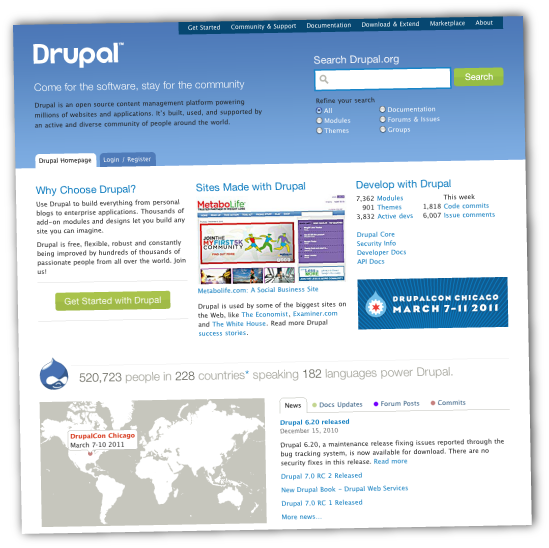
Screenshot of the newly redesigned Drupal.org.

Drupal.org Redesign Completion

Drupal.org has a new look and feel. If you have not seen it (have you been under a rock!?) go check out Drupal.org right now!

It took a few years and many iterations and volunteers, and even that was not enough. This year the Drupal Association came to the party with funding to finish the job. Contracts went to tender and were won by Neil Drumm, Achieve Internet and 3281d Consulting.

Thank you to everyone who contributed to the Drupal.org redesign for all your hard work and effort to pull this off. And especially thank you to the Drupal Association for funding the last several miles that could not be covered by volunteers alone.

Drupal.org will never be the same again! Find out what is next for Drupal.org.

DrupalCon San Francisco
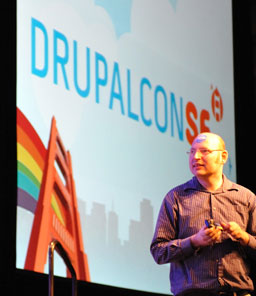
Photo of chx with a large DrupalCon San Francisco logo on the projector screen behind him.
Photo by Kathleen Murtagh

How could we ever forget? DrupalCon San Francisco, was epic. By all measures, it was the largest and most spectacular Drupal event yet.

The Drupal Association bootstrapped the funding and locked in critical contracts in order to secure the venue and other services. Many of the DrupalCon San Francisco committee members also serve the Drupal Association. The Drupal Association managed all the finances for the event and coordinated the local team and service providers with the rest of the Drupal community.

And that is just the beginning of what the Drupal Association did to make DrupalCon San Francisco a reality!

Git Migration

Photo of Sam Boyer posing with a Druplipet on his head.
Sam Boyer. Photo by Fox

The Drupal Association recognized the urgency to update Drupal.org's version control system (currently CVS).

Drupal has an active, amazingly awesome and amiable community. One of the reasons for this, is that Drupal.org is our home. It has everything Drupal developers need, all in one place. However the last couple of years has seen a trend for contributions to be distributed elsewhere.

The Drupal Association realised that if Drupal.org did not offer modern version control and code-distribution tools, then Drupal.org would cease to be a central repository for contributed Drupal code. And that would ultimately be damaging to the community and the project.

Git logo

So earlier this year, the Drupal Association hired Sam Boyer to work on detailed planning and foundation work in preparation for the migration of Drupal's gigantic CVS repository, including about 9000 contributed themes modules and other projects, to Git.

This work is underway and is making good progress, but has some way to go yet. Sam is leading the effort but the success of the project is highly dependent on volunteer effort too. You can get involved on g.d.o.

What’s next for Drupal.org

With the Drupal.org redesign launched, I’ve heard many ask, “what’s next?” We always do regular, incremental improvements through the infrastructure and webmasters projects. This will continue, with the new design as a foundation and deployment workflow improved by the redesign project.

Facepalm

I've found some time to investigate some drupal.org server logs and found that while everything is generally working, there are some strange things happening.

Every full hour our access stats go up by almost 150%. I looked at the IPs that produce a lot of hits over the day, but they weren't responsible for these spikes. The spike is produced by a lot of different Drupal sites that request our update data when the hour strikes.

And why? Because we tell them to! In line 239 of our INSTALL.txt we instruct people who install Drupal to request our update stats at precisely that time. A classical facepalm.

Thanks to Varnish and the generally robust drupal.org infrastructure, this isn't an actual problem, but with the continued growth of the number of Drupal sites it might become one.

Pages

Subscribe with RSS Subscribe to RSS - drupal.org